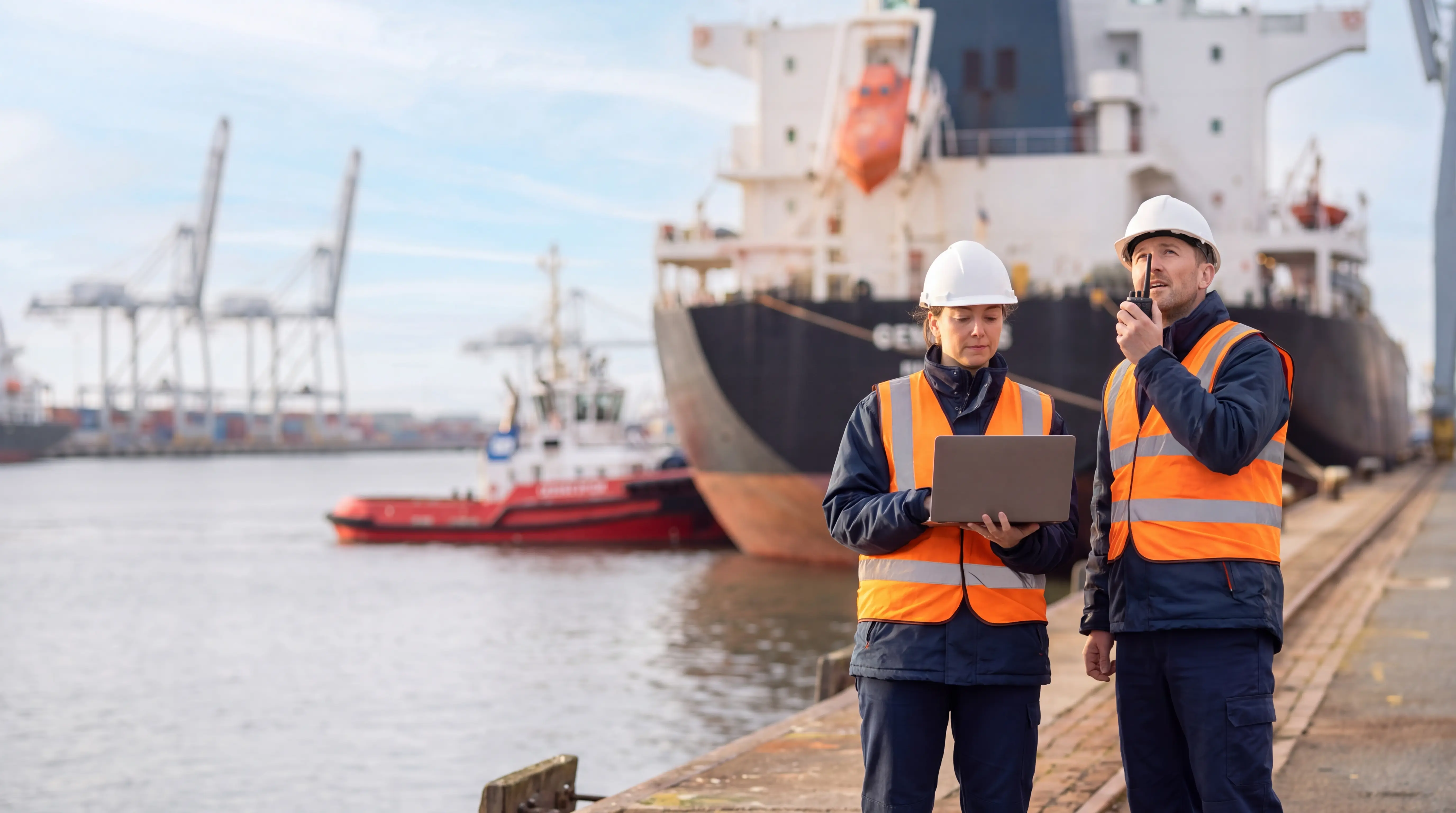

A vessel reports a new ETA. Within the hour, the pilot needs to be rescheduled, the tugs rebooked and the berth reconfirmed, while the crew change and provisions shift along with it. And the principal wants to know what it all means.
For a port agent, this is not an exception. It is an ordinary working day.
The port agent is where all parties in a port call come together: principal, port authority, pilots, towage, terminal, customs and suppliers. Everything runs through you, and usually under time pressure.
Where the overview gets lost
Most information arrives by email, phone, messaging apps and the portals of different parties. As a result, the current status of a port call often lives in a mailbox, and in the head of the person handling the file.
Sound familiar?
- A changed ETA has to be passed on manually to every party involved
- Documents for a port call are scattered across mailboxes, folders and portals
- The principal calls for an update, while the answer is buried in an email thread
- A colleague takes over a file and first has to work out what has already been arranged
- After departure, it takes days to gather all documents and costs for the final settlement
Each of these can be solved on its own. Together, they make your organisation dependent on a few people who know exactly where everything is.
Why this matters more than it seems
- The work does not scale: more port calls mainly means more people, not more overview
- Errors happen in handovers: a missed change or a forgotten confirmation
- Principals judge you on speed and reliability. If you have to search first, you respond later
- Knowledge sits with people. During holidays, sickness or peaks, that becomes fragile
In short: you deliver quality thanks to the commitment of your people, not thanks to your systems.
From mailbox to one file per port call
A more effective approach starts with one place per port call. That is where planning, status, documents, services, communication and costs come together. Whatever changes is recorded once and is immediately visible to everyone working on the call.
What this means for you:
- A changed ETA is recorded once and is instantly visible to the whole team
- Documents belong to the port call, not to a mailbox
- The status of every ongoing port call is visible at a glance
- Handing over a file means opening it, not reconstructing it
What this changes in practice
- Faster and more reliable answers to questions from principals
- Fewer errors in handovers between colleagues and parties
- Handling more port calls without a matching increase in staff
- Documents and costs are ready when the vessel sails
- Knowledge sits in the system, not only in people’s heads
And perhaps most importantly: your people spend their time arranging, not searching.
Why it matters
The work of a port agent is not getting simpler. More parties are involved, schedules are tighter and principals expect clarity faster than ever.
Ultimate Maritime Logistics has been working with organisations across the maritime chain for more than twenty years. We know that a port agent works differently from a terminal or a liner. With Flex Maritime Logistics on Microsoft Dynamics 365, we support the entire chain on one platform, tailored to the reality of every role. Including that of the port agent.
Curious how your port calls fit into one overview?
Feel free to get in touch. We are happy to walk through one recent port call with you and show where the overview gets lost.