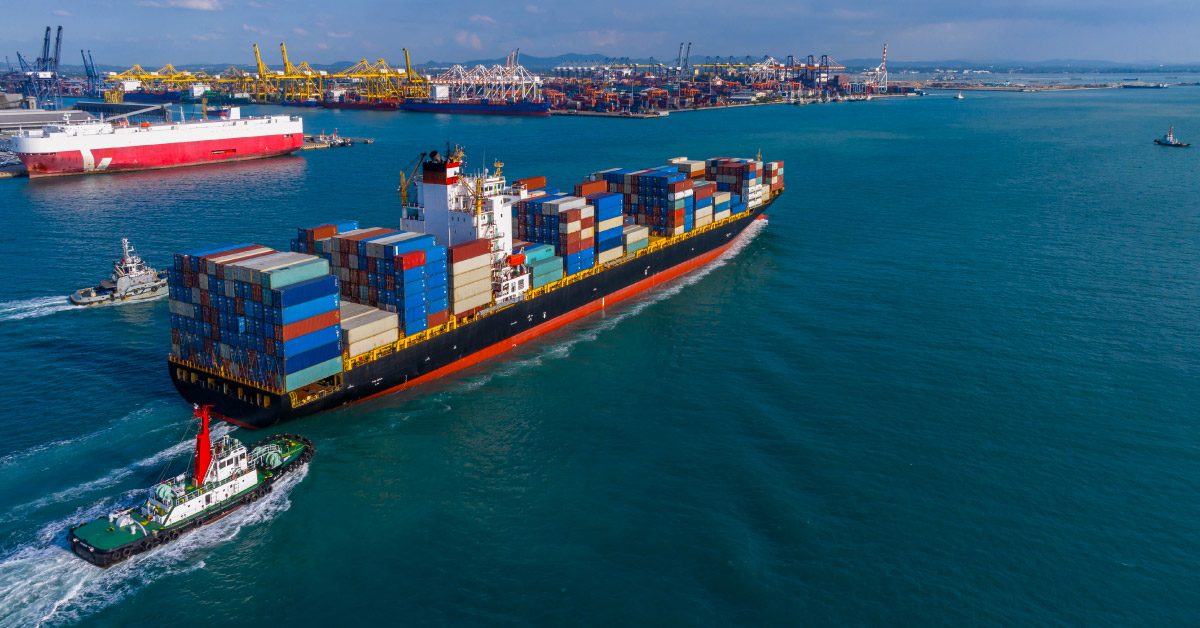

A Non-Vessel Operating Common Carrier (NVOCC) is a logistics service provider that purchases vessel space from carriers and sells it on to shippers — without operating ships itself. You organise the full chain: from booking and document management to invoicing and compliance. You are a contractual party on both sides simultaneously. Towards the carrier with a Master Bill of Lading, towards the shipper with a House Bill of Lading.
That makes your position fundamentally different from a regular freight forwarder.
Where things go wrong
Most NVOCCs start with an operational booking system and fill the gaps with spreadsheets. In the early stages, this works. But the day-to-day reality of a NVOCC is anything but simple: consolidating and deconsolidating LCL shipments, managing House and Master Bills of Lading, tracking containers across multiple carriers. Changes to routes, delays and exceptions are not edge cases — they are the rule.
At the same time, you are continuously connected to carriers, terminals, customs, freight forwarders and transporters. All those parties generate data. And all that data needs to come together somewhere — ideally in one system, not scattered across carrier portals, emails and spreadsheets.
As the organisation grows — more FCL and LCL bookings, more consolidations, more trade lanes — the system starts to crack. The link between what has been agreed operationally and what needs to be processed financially is made manually. Every single time.
Familiar?
- Rate discrepancies between purchase costs and sales invoices that only surface at reconciliation
- Purchase costs that are not automatically linked to the correct booking
- Finance depending on operations to collect data before reporting can begin
- Month-end close that takes hours instead of minutes
- Limited visibility into margin per shipment, profit per container or performance per trade lane
- Customers calling for container status or ETA updates you have to look up manually yourself
Each of these is manageable on its own. Together, they become a structural brake on growth.
The in-between position demands an integrated system
As a NVOCC, you depend on data flowing in from two directions: what you buy from the carrier and what you sell to the shipper. Those two streams need to connect continuously — not after the fact, but in real time.
Add to that the rate complexity every NVOCC knows. Ocean freight rates shift weekly. Contract rates and spot rates run in parallel. Surcharges such as BAF, CAF and PSS are calculated differently per carrier and need to be correctly passed through in quotes, calculations and invoices. Local charges vary by port. Exchange rate fluctuations in USD, EUR or CNY have a direct impact on the final margin.
A system that does not handle this automatically puts the pressure on your people. And people make mistakes — especially when doing this alongside dozens of other tasks.
That means your operational booking system and your financial administration cannot be separate components. When an LCL consol is confirmed, purchase costs should be captured immediately. When a shipment closes, the sales invoice should be ready automatically. When a route changes or an ETA shifts, the impact on planning and invoicing should be visible straight away.
No manual handovers. No interpretation gaps between operations and finance. One single source of truth.
From spreadsheet to scalable operation
The move to an integrated platform is not only a technical decision. It is a strategic one.
Organisations that integrate operations and finance gain visibility they never had before: margin per shipment, profit per container, return per customer, performance per trade lane. They invoice faster, report more accurately and make better decisions about growth, pricing and customer relationships.
Customers also expect real-time visibility into their shipments — container locations, ETAs, delays and exceptions. When that information is only available through separate systems or manual updates, it does not just cost time. It costs the relationship.
The step from spreadsheet to a mature ERP environment is often larger than expected. Not because the technology is complex, but because processes need to be redesigned. That requires a partner who genuinely understands how a NVOCC
operates — not someone selling you a generic system, but someone who knows your operational reality.
What this changes in practice
With an integrated approach, the day-to-day operation changes immediately:
- Purchase costs are automatically linked to the correct booking
- Rates, surcharges and local charges are correctly passed through in quotes and invoices
- Sales invoices are generated faster and with fewer errors
- Finance and operations work from the same data
- Month-end close becomes a verification, not a recovery exercise
- Customers get real-time visibility into their shipments — without your team having to look up information manually
- Growth no longer has to mean more people for more administration
Want to know what this means for your margin per shipment?
We will show you — based on your own operation. In a one-hour conversation, we identify exactly where your current processes are leaking value and what an integrated approach would concretely deliver for your shipment profitability, month-end close and scalability.
Schedule a conversation or get in touch with our team directly.